What You Can (and Can't) Store in a Self-Storage Unit
A clear, local guide to what's welcome in a Richland or Kennewick storage unit — and what's not allowed by law, insurance, and common sense. Save yourself a trip.
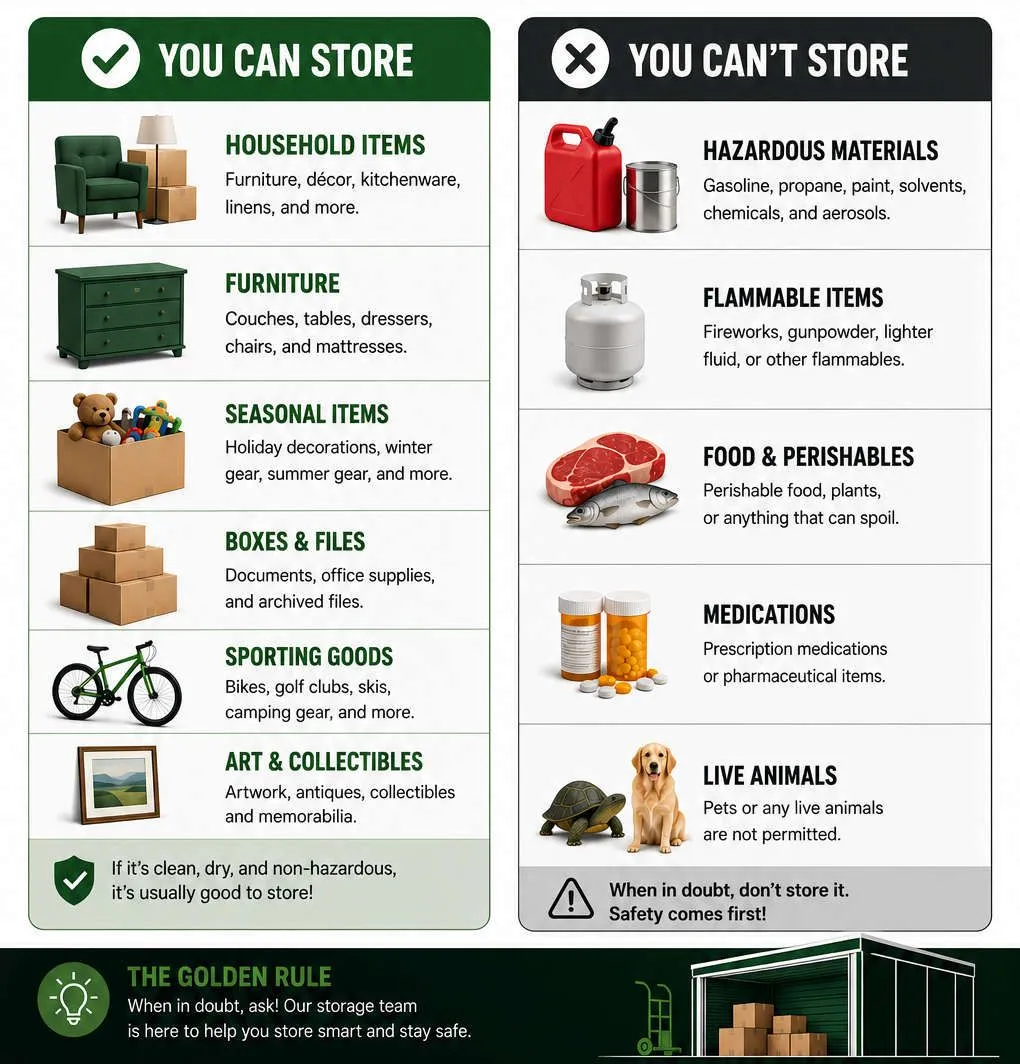
Short answer: if it’s clean, dry, and non-hazardous, it’s almost certainly welcome. The “no” list is shorter than people think — flammables, perishables, medications, and anything alive. Most of it is common sense; the rest is in your rental agreement.
This guide walks through both sides so you can pack the truck once and not get turned away at the gate.
What you can store
Most household and small-business belongings store beautifully in a Tri-Cities storage unit. A few categories worth calling out:
Household items. Furniture, décor, kitchenware, linens, glassware, lamps — the everyday contents of a home in transition. Wrap fragile items, leave a center aisle, and you’re set. If you’re storing during a remodel or move, our size guide helps you pick the right footprint.
Furniture. Couches, dining tables, dressers, bed frames, mattresses, office furniture. Wood and upholstery do best in climate-controlled units — Columbia Basin summers swing past 100°F and winter nights dip below freezing, and that movement is what cracks veneers and dries out leather over time.
Seasonal gear. Holiday decorations, winter coats and skis in summer, summer gear in winter, lawn furniture in the off-season. This is one of the most common reasons people rent a 5×10 — see the 5×10.
Boxes, documents, and files. Tax records, archived business files, photo albums, books. Use sturdy boxes (not grocery-store cardboard), label them on two sides, and stack heaviest on the bottom. Paper and photos do best in climate control — humidity is what curls and yellows them, not just heat.
Sporting goods. Bikes, golf clubs, skis, snowboards, kayaks (small ones), camping gear, fishing tackle. Drain anything that holds water, and store bikes hung or upright to protect tires.
Vintage furniture and everyday memorabilia. Older furniture, framed prints, books, photo albums, and the kinds of family keepsakes most households accumulate. Climate-controlled units protect wood, paper, and upholstery from Tri-Cities temperature swings — see Why Choose Climate-Controlled Storage in Richland, WA? for the longer case. For high-value pieces — fine art, jewelry, irreplaceable heirlooms — a bank safe deposit box or specialty storage is a better fit, and our rental agreement asks you to keep those items elsewhere.
Tools and equipment. Hand tools, power tools, ladders, lawn mowers (drain the gas first — see below), small contractor gear. A drive-up unit is usually the right call for tools you pull out weekly.
Vehicles, boats, and RVs. Cars, motorcycles, project vehicles, boats, jet skis, ATVs, trailers. We have dedicated vehicle storage and boat storage options, plus larger drive-up units that fit a vehicle plus extras.
Appliances. Washers, dryers, refrigerators, freezers, microwaves. Critical: clean and fully dry them before storing — a damp fridge will mildew in a sealed unit within weeks. Prop doors slightly open if possible.
Business inventory and records. Retail stock, e-commerce inventory, sales samples, archived files. Many small businesses in the Tri-Cities use a storage unit as overflow — it’s typically a deductible business expense (ask your accountant). One note: units are for storage, not for running operations out of — packing, shipping, or workshop activity inside the unit requires prior written permission.
What you can’t store
A handful of items are not allowed — by Washington state law, federal law, our lease, or your homeowner’s/renter’s insurance policy. The rules below are industry-standard; you’ll find similar lists at any reputable self-storage facility in Richland, Kennewick, or anywhere else in the country.
Hazardous materials. Gasoline, propane tanks (full or partial), kerosene, motor oil, paint, paint thinner, solvents, pesticides, fertilizer, pool chemicals, aerosol cans. These are fire and contamination risks. Drain fuel and disconnect propane before storing anything with a tank — lawn mowers, generators, grills, RVs.
Flammables and explosives. Fireworks (yes, even the legal-in-Washington ones), gunpowder, lighter fluid, charcoal lighter, road flares, matches in bulk. If it’s designed to ignite, it doesn’t belong in a sealed unit.
Food and perishables. No fresh food, no frozen food, no pantry items, no pet food, no plants. Even sealed canned goods are a bad idea — they attract pests, and a single broken can ruins a unit. Pro tip: the night before you move in, vacuum the inside of any drawers, ovens, or appliances, then leave a few cedar blocks or unopened baking soda boxes inside.
Medications and pharmaceuticals. Prescription medications, OTC bulk stock, supplements, and anything you’d take internally. Temperature swings degrade most medications quickly, and prescriptions are safer kept at home where they belong with the person they’re prescribed to.
Living things. No pets, no livestock, no aquariums (even empty ones with residual water), no plants. Units have no climate ventilation suitable for life, and animal welfare laws apply.
Stolen or illegal goods. Obvious, but worth saying: anything the law doesn’t allow you to own, you can’t store. This includes unregistered narcotics, items with altered serial numbers, and goods you don’t actually own.
Cash and irreplaceable valuables. Not strictly prohibited, but not a great idea — a safe deposit box at your bank is a better home for large cash, original deeds, passports, and uninsured jewelry. Storage units are well-secured (we have 24/7 video, individual door alarms, gate codes), but they’re not bank vaults.
Anything wet, moldy, or actively leaking. This includes appliances that haven’t been fully dried, recently-used coolers, damp camping gear, or anything stored “to deal with later.” Moisture is what destroys neighboring units.
A few “ask first” gray areas
Antique vehicles with fuel. If you’re storing a classic car or motorcycle indefinitely, drain the fuel and disconnect the battery. Short-term (a few weeks) with a near-empty tank and a battery tender is usually workable — ask us.
Wine and spirits. Allowed for personal collections in reasonable quantity. Climate-controlled is essential — wine especially can’t tolerate the temperature swings of a drive-up unit in the Tri-Cities.
Refrigerators and freezers. Allowed, but only clean, dry, and empty. We’ve seen too many “I forgot to empty the freezer” moves to skip this warning.
If you’re not sure about an item, call us at (509) 827-1927 — we’d much rather answer the question than have you make two trips.
Why these rules exist
Three reasons, in order of importance:
- Safety. Fires in storage facilities are almost always traceable to flammables or fuel. The rules above are the lessons the industry learned the hard way.
- Your insurance coverage. Most homeowner’s and renter’s policies extend to stored belongings — but only if the stored items themselves are allowed. Storing prohibited items can void coverage for everything else in your unit.
- Your neighbors. A leaking propane tank or a spoiled freezer doesn’t stay inside one unit. Keeping the “no” list short and clear is what protects the people next door to you.
Ready to rent?
Live pricing and unit availability are on the Pricing page. For a same-day answer on a specific item — can I store this? — call (509) 827-1927. Tyler or someone from the office can usually answer on the first or second ring.
- Serving Richland, WA
- Serving Kennewick, WA
- See all unit sizes
- First-time renter info
Related reading:
Ready to reserve your storage unit?
Storage Station is located at 101 E Reata Rd in Richland, just off I-82 near Clearwater Ave. Reserve online in minutes or call us during office hours.